The $1,000 Misunderstanding: Why Technical Jargon is Killing Your Approval Rates
By GarageInsight Team · · 7 min read
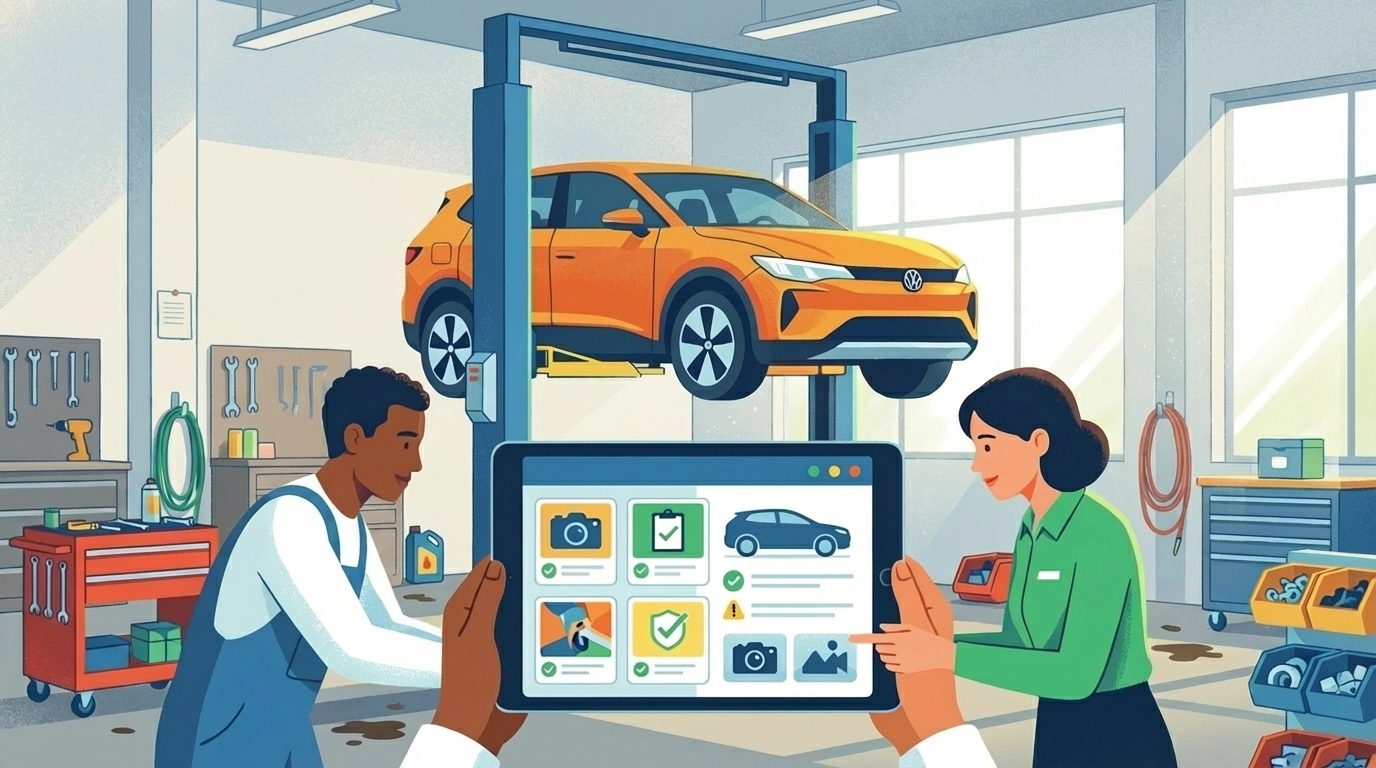
Real shop notes aren’t essays.
They look like: “pad 3mm, rotors toast, R+R reqd.” “batt 11.6v, alt ok.” “oil seep @ VC—monitor.”
- Tech shorthand is fast in the bay—and fatal at the counter.
- Customers see “expensive mystery,” ghost the estimate, and leave.
The $1,000 repair disappears not because it wasn’t needed, but because it wasn’t understood.
This is daily reality for family-run and high-volume shops:
- Slow inspections
- Low ARO
- Stalled approvals
Profit Psychology in the bay is simple—when people feel confused, they say no. Clarity closes.
The Translation Gap That's Costing You Money
In real life, tech notes are incomplete, half-sentences, and internal.
- “R+R,” “seep @ VC,” “pad 3mm” makes sense to a veteran—nothing to a driver.
- The gap between bay shorthand and plain-English, photo-backed explanations is where trust breaks and approvals die.
- You don’t need to retrain technicians; you need a translation layer that turns shorthand into trust—instantly.

What Your Current Process Actually Sounds Like to Customers
Real-world tech communication isn’t just “technical.” It’s incomplete, shorthand, and nearly uninterpretable to customers. Below are typical bay notes (sanitized) and what our Auto repair AI generates for customers—photo-backed, plain language, VIN-specific context, OEM prompts.
- What tech wrote:
pad 3mm, rotors below min, R+R reqd. fluid dark, pedal soft. - What AI report generated:
Front brakes are worn to 3mm (thin). Rotors are below the manufacturer’s minimum thickness, which increases stopping distance. Replace pads and rotors today and service the brake fluid to restore a firm pedal. Photos show pad thickness and the rotor mic reading. VIN-specific spec for your vehicle used in this recommendation. - What tech wrote:
LF CV boot torn, grease out, click on turn. axle play—advise replace. - What AI report generated:
The left front axle boot is torn, letting dirt in and grease out—causing the clicking when you turn. Replacing the axle now prevents sudden failure. Photos show the tear and grease. At current mileage, OEM guidance supports replacement on this visit. - What tech wrote:
batt 11.6v KOEO; alt 14.2v; load test fail; parasitic draw? chk ok. - What AI report generated:
Your battery tested low at 11.6v and failed our load test. The alternator is charging correctly at 14.2v, so the battery is the issue. Replacing it prevents no-starts. We also checked for overnight power drain; none found. Photo shows the test result on our meter. - What tech wrote:
serp belt cracking; WP seep; monitor vs est? - What AI report generated:
Your main drive belt shows cracking and the water pump has a light coolant seep. Replace the belt today; plan the water pump soon before the seep becomes a leak. Photos show the belt wear and seep area. OEM prompts around this mileage align with the recommendation.
You’re not losing customers because you’re wrong. You’re losing them because your notes require a translator.
The AI Translation Revolution
This is the missing link. Even if your techs won’t change how they write, Garage Insight’s Auto repair AI converts bay shorthand into customer-ready clarity—instantly. With our AI Translator and AI-powered summaries, you get a mechanic jargon translator, an explain auto repairs to customers tool, and a vehicle inspection comments generator in one.
How it works in your shop:
- Tech writes the way they always do (pad 3mm, R+R reqd) and adds photos.
- We pull VIN-specific context via VIN Lookup, apply OEM intervals and prompts, and understand the component in the note and photo.
- The AI generates a photo-backed, plain-English explanation with safety impact, what-happens-if-I-wait, and clear next steps—structured for approvals.
- You share the inspection instantly by text/email so customers see photos, notes, and a clear decision path within minutes.
Quick before/after:
- What tech wrote:
rear pads 2mm, rotors min, R+R reqd; fluid dark. - What AI report generated:
Rear brakes are worn to 2mm (thin). Rotors are at the minimum thickness, which lengthens stopping distance. Replace pads and rotors today and service the brake fluid to restore a firm pedal. Photos show pad thickness and the rotor mic reading. VIN-specific spec was used for your vehicle.
This is how shops increase repair approval rates and boost auto shop ARO (Average Repair Order) without retraining the bay—by translating shorthand into trust at the moment it matters.

The Trust Bridge That Drives Approvals
Notice what happens in these translations? The AI doesn't just simplify the language: it bridges the trust gap by:
- Explaining the "why" behind each recommendation
- Connecting problems to consequences customers actually care about
- Using everyday language that builds understanding instead of confusion
- Focusing on safety and value rather than technical specifications
When customers understand what's actually wrong and why it matters, they stop seeing repair recommendations as sales pitches and start seeing them as helpful advice from a trusted expert. That's building customer trust in auto repair—at scale.
The 40% Improvement You Can't Ignore
+40% repair approval rate vs. technical write-ups alone using digital inspections with Auto repair AI—plain language plus structured, photo-backed evidence (internal benchmark across participating shops; see sources below).
Turn comprehension into conversion with the AI Translator:
- From 60% to 84% approval = nearly 9 out of 10 recommendations closed.
- At $500 ARO, that lift adds +$100–$150 per vehicle depending on mix and bay-cycle throughput.
- Small gains, big impact—across the week and every bay.

Why Your Competitors Are Still Stuck
Most digital inspection tools focus on photos and checklists, but they're still delivering the same confusing technical jargon to customers. They've digitized the problem without solving it. Your competition is still losing customers to the translation gap while you're building bridges.
The shops winning in 2026 understand that technology isn't just about efficiency: it's about communication. When you can take your technician's expert diagnosis and instantly translate it into customer-friendly language, you're not just documenting problems. You're building the trust that drives approvals.
The Hidden Cost of Technical Accuracy
Every declined repair costs you more than just that single job. It creates a customer who:
- Questions your honesty and expertise
- Tells friends about their "overselling" experience
- Takes their vehicle elsewhere for future service
- Becomes skeptical of all future repair recommendations
That $1,000 brake job they declined? It might actually cost you $10,000 in lifetime customer value when you factor in lost future business and negative word-of-mouth.
Making the Switch Without the Headache
- No retraining: Techs keep writing the way they do today—fast shorthand, photos attached.
- Auto translation: Our Auto repair AI turns technical accuracy into customer clarity without adding steps.
- VIN-specific precision: Context comes from VIN Lookup and OEM logic for consistent, correct recommendations.
- Instant sharing: Send reports by text or email with Instant Sharing so customers see photos, notes, and clear next steps right away.
Your techs diagnose and recommend. The AI communicates for approvals.
The Path Forward
The shops thriving in 2026 will be the ones that master the art of technical excellence and customer communication. You don't have to choose between being accurate and being understood. With the right tools, you can be both.
Stop letting technical jargon kill your approval rates. Your customers want to trust you, understand you, and approve the repairs their vehicles need. Give them the clear, honest communication they're looking for, and watch your approval rates: and your revenue: climb.
Ready to close the translation gap in your shop? Explore AI-powered inspections with our AI Translator and Instant Sharing to increase repair approval rates and boost auto shop ARO—without changing how your team works.
Sources & Industry Research
- Customer Communication in Auto Repair: Best Practices for Shops – Orderry (n.d.).
- How to Build Trust with Auto Repair Shop Customers – Solera (n.d.).
- Digital Vehicle Inspections: What They Are and Why They Matter – PartsTech (n.d.).
- Digital Vehicle Inspection Best Practices – AutoVitals (n.d.).
- How to Increase Average Repair Order Revenue – Kimoby (n.d.).
- Increase My ARO or Increase My Car Count? – Bolton Technology (n.d.).
- The State of General Auto Repair Shops in the United States – PartsTech Report 2025 – PartsTech (2025).